
Khan took strong exception to the Inter-Services Public Relations (ISPR) allegations against him and said the spokesperson of the army's military wing was not even born when he represented Pakistan in the world.

'...The more the Pakistan army becomes weaker, then there is every possibility that terrorist groups may create more anarchy in Pakistan.'

Citing sources within the Federal Investigation Authority (FIA), the Geo News reported that the names of the PTI leaders and its party chief have been added for their involvement in the May 9 violence and desecration of martyrs' monuments.

'Here in Delhi, the Modi government is supposedly looking at 'options' to hit back at Pakistan in any whichever way it can, while in Washington, the Obama administration is looking for ways to strengthen US military cooperation with Pakistan,' says Ambassador M K Bhadrakumar.

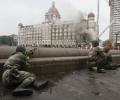
Experts trace the reasons for the 26/11 attacks to the Pakistan's military interest in three key areas: Kashmir, Afghanistan and nuclear armaments.
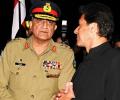
How Pakistan army chief General Qamar Javed Bajwa deals with the ensuing reshuffle of lieutenant generals would be interesting to watch, notes Rana Banerji, who headed the Pakistan desk at the Research and Analysis Wing, India's external intelligence agency.

India is not making a choice of war over peace. Rather it is at war, a war thrust on it by a sick militaristic State, says Sankrant Sanu.
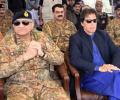
Lieutenant General Faiz Hamid will take to his new command as duck to water, notes Rana Banerji, who headed the Pakistan desk at the Research and Analysis Wing, India's external intelligence agency.
'Rawalpindi must downsize its quest for 'strategic depth' in Afghanistan and Kashmir,' suggests Matein Khalid.

'Jaish looked to creating regional mayhem, at a time when peace appeared more likely, and when that peace would have threatened Jaish's existence.'
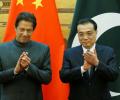
'Listing Masood Azhar as a 'global terrorist' was done with Islamabad and Imran Khan's concurrence.' 'It was not prompted by the so-called 'Wuhan spirit'.' 'The relationship between the two 'iron brothers' has not been dented,' points out former RA&W officer and China expert Jayadeva Ranade.

'Jaish aided by LeT attacked Parliament knowing mobilisation of Indian military assets would be the consequence.' 'That mobilisation happened, necessitating a military response from Musharraf who moved troops guarding back doors out of Tora Bora, facilitating Osama's escape.'
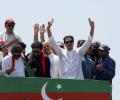
There has always been a risk-taking edge to Imran Khan. Like him or hate him, it had to be someone like him to finally threaten to demolish the Pakistani establishment, explains Shekhar Gupta.

The Taliban is showing its strong discontent as the high hopes given to it by the Pakistani military have been dashed, observes Ambassador M K Bhadrakumar.
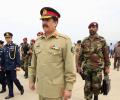
Nawaz Sharif may have permitted the trial of Jaish-e-Mohammed terrorists for the Pathankot attack. But this fell apart because of General Raheel Shareef's keenness to make Kulbhushan Jadhav the centerpiece of global attention. Ambassador G Parthasarthy, a former Indian high commissioner to Pakistan, reveals the Pakistan army chief's gambit against India.

'There is a sense of realism in the Pakistan army that if they needled India during the Ladakh standoff, they would have seen a strong retaliation.' 'Pakistan was hoping that India would come out looking weaker in the region and get embarrassed, but that obviously has not happened.'

'By beheading an Indian soldier, the Pakistan army has demonstrated its proclivity for barbaric medievalism.' 'The strategies adopted and the punishment inflicted by India must be made progressively more stringent with every new act of terrorism till the cost becomes prohibitive for Pakistan,' says Brigadier Gurmeet Kanwal (retd).
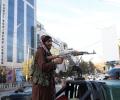
Delhi has come to accept the Taliban takeover in Kabul as a reality and seems increasingly unsure of its dogmatic view of the Taliban as a mere proxy of the Pakistani military and security establishment, observes Ambassador M K Bhadrakumar.
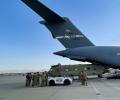
Remember the US withdrawal agreement was signed in February 2020. In the intervening period, a proper evacuation plan ought to have been in place. It was not. Consequently, tens of thousands of Afghans who had worked as interpreters, drivers, suppliers of goods and services, etc, face brutal retribution from the Taliban, Virendra Kapoor points out.

'The China Pakistan Economic Corridor is Pakistan's number one preoccupation today -- and tensions with India and the $46 billion projects simply do not go together,' points out Ambassador M K Bhadrakumar.

If the Taliban have proved one thing over these two decades, it is that they are way smarter than their big brother, observes Shekhar Gupta.

But why should India be talking to the Taliban in the first place? There is no love lost there. India will never forget or forgive the humiliation to which the Taliban subjected it in the IC-814 hijack, notes Shekhar Gupta.

'India in 2020 is a lot better prepared than in 1962.' 'It is no longer a pushover; and anything other than a crushing Chinese military victory will be a major loss of face for China,' observes Rajeev Srinivasan in the first of a three part column.
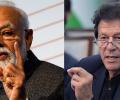
Modi's hardline policy towards Pakistan and J&K has created numerous leverages and bargaining positions that New Delhi can bring to the bargaining table and translate into concessions, argues Ajai Shukla.
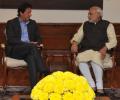
Should India engage Pakistan's generals directly, bypassing Imran? Ambassador G Parthasarathy, India's former high commissioner to Pakistan, ponders Delhi's diplomatic dilemma.

'Washington is telegraphing here is its willingness to support a low-grade, limited use of force meant to send a strong message to Pakistan.' 'Perhaps something along the lines of the surgical strikes in 2016, or perhaps something a bit more -- but not much more.'

'Pakistan's military leaders have to accept that the policy of proxy wars has damaged Pakistan more than it has damaged the enemy,' says former R&AW chief Vikram Sood.

'He has a splendid opportunity to capitalise on the CPEC and turn the economy around decisively, putting Pakistan firmly on a higher growth trajectory.' 'Indeed, under the Imran-Bajwa dispensation, there has been a noticeable whittling down of support to militant groups,' points out Ambassador M K Bhadrakumar.

China's closer and enhanced relationship with Pakistan is putting considerable strain in India-China relations, says former RA&W officer Jayadeva Ranade.

Even as Prime Minister Nawaz Sharif headed to the United States for the 70th session of the UNGA and for bilateral meetings to be held on the sidelines of the multilateral summit, back home all that is expected of him is to internationalise the Kashmir issue, or as Pakistan puts it, the 'Kashmir dispute'.


During a war, there are just four possibilities a soldier faces. One: Victorious and safe. Two: Wounded. Three: Killed in action. Four: Prisoner of War. It was my fate to face the fourth, says Colonel Anil A Athale (retd) on the year spent as a prisoner of war in Pakistan during the 1971 War.
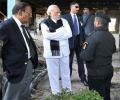
'Imran Khan would only have spoken with the full awareness of Modi's complex political personality.' 'He has the great advantage of being privy to the confidential exchanges between then Pakistan prime minister Nawaz Sharif and Modi during the latter's celebrated surprise visit to Lahore in December 2015 as well as the 'back channel' conversations between the national security advisors of the two countries,' says Ambassador M K Bhadrakumar.

'Clearly, the Modi government is proving to be far more willing than any previous government in Delhi to hitch India's wagons with the US' regional strategies.'

The question really is whether the US can be persuaded to embark on a path of calibrated and stronger sanctions on Pakistan.
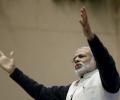
'Modi's brilliance seems to be in combining Indira Gandhi's 'feel' for the Indian pulse and Narasimha Rao's cynicism.' 'By the time the Opposition leaders caught up with Modi over the 'surgical strikes', he had already moved on,' says M K Bhadrakumar.

Indian policymakers must incorporate in their nuclear doctrine a realistic response to tactical nuclear warheads, says Ajai Shukla.
Through its early days to the 1980s, Pakistan sought to expand its sphere of Islamic influence through Afghanistan to Central Asia and got Pakistani citizens recruited in the Afghan government institutions in the 1990s when the Taliban were power. Now, it is looking eastward through India to Bangladesh and Myanmar to establish an imaginary caliphate.
